Nirgendwo






Artists: Mila Panić, Igor Ruf, Marko Tadić, TARWUK
Curator: Martina Marić Rodrigues
Exhibited works selected from the Cerin Antonić Collection
Nirgenwdo
…I resume, not the good fortune to establish, with regard to me, if it’s I who seek, what exactly it is I seek, find, lose, find again, throw away, seek again, find again, throw away again, no, I never threw anything away, never threw anything away of all the things I found, never found anything that I didn’t lose, never lost anything that I mightn’t as well have thrown away, if it’s I who seek, find, lose, find again, lose again, seek in vain, seek no more, if it’s I what it is, and if it’s not I who it is, and what it is, I see nothing else for the moment, yes I do, I conclude, not the good fortune to establish…
-The Unnamed, Samuel Beckett[1]
The layers of the world graft themselves onto one another. Present and past futures grow and entwine with future presents and pasts. All of this takes place in the midst of permeations and transformations; in the branching out of fine lines and the empty spaces between them. These “empty spaces”, “in-betweens” as W.G. Sebald dubs them,[2] are gaps in space and rifts in time, places where our existential nausea is collected. Confronted with a reality that twists into itself, we struggle to make sense of the world and are at once faced with its deeply indeterminable nature. How can one live in a time that at once shapes us and transcends us? How can we understand who we are, and our presence in a world that seems ambivalent to our existence?
At the exhibition Nirgendwo (meaning “nowhere” in German), four micro-stories are allowed to develop. Mila Panić, Igor Ruf, Marko Tadić, and TARWUK exhibit works that exist on the “thresholds” between that which is and that which might be – neither fully rooted, nor fully displaced – but rather immersed in constant change.
Suveniri (Souvenirs)
Things (for the most part) outlast us. The objects we create, that we live with and use, and eventually abandon, can survive longer than we. And not just in the physical sense. Even when they lose their original function, when we stop using them, they are still here, stubbornly enduring.
Marko Tadić is an artist that searches, sifts through, stores – fills up the reservoirs of memory – a physical and associational archive that is the foundation of his artistic practice. In the work Suveniri (Souvenirs) he likewise relies on an inherited inventory of the everyday. He begins with discarded memorabilia, old wooden plates featuring panoramas of various tourist destinations such as Dubrovnik, Zadar, Bled, Pula, and various landscapes. Once the spoils of travellers’ collecting rituals, these small artefacts reflecting personal history are items that are immensely trivial and at the same time deeply meaningful as nostalgic reminders of the (good) old days. Pushed out of one life cycle, they retreat to the depositories of memory. From here, Tadić extracts them and uses them to create a bricolage of new stories. His process reflects what Clause Lévi-Strauss called the “wild thought” (la pensée sauvage),[3] an intuitive and metaphorical mode of thinking that extracts fragments and symbols from past experiences, joining them into new meaning structures.
Through subtle or radical interventions, Tadić “outmanoeuvres” the clichéd touristic vedute. Familiar places are scattered, obscured, or mutated, and a general air of melancholy creeps in. “Is this home (Was it ever home)?”, “Celebrating nonsense?”, and “Wish you were here” are just some of the messages that have been written on them. Though they are imaginary places, life’s traumatic core remains. Traumas, both personal and collective, do not disappear, but rather remain permanently inscribed on our perception of reality, through the traces of the past. But in Tadić’s work entropy is neither the aim nor the endpoint, but rather a part of the process. The depositories and archives that he explores return as places where one can find pleasure in melancholy, and in his objects as a constant negotiation between erasure and creation, “empty spaces” and speculative futures.
Frizerski salon za brdo (Hairdresser for the Hill)
There’s a place in this world / Where the wind blows endlessly / Woosh Woo / Woosh Wooo[4]
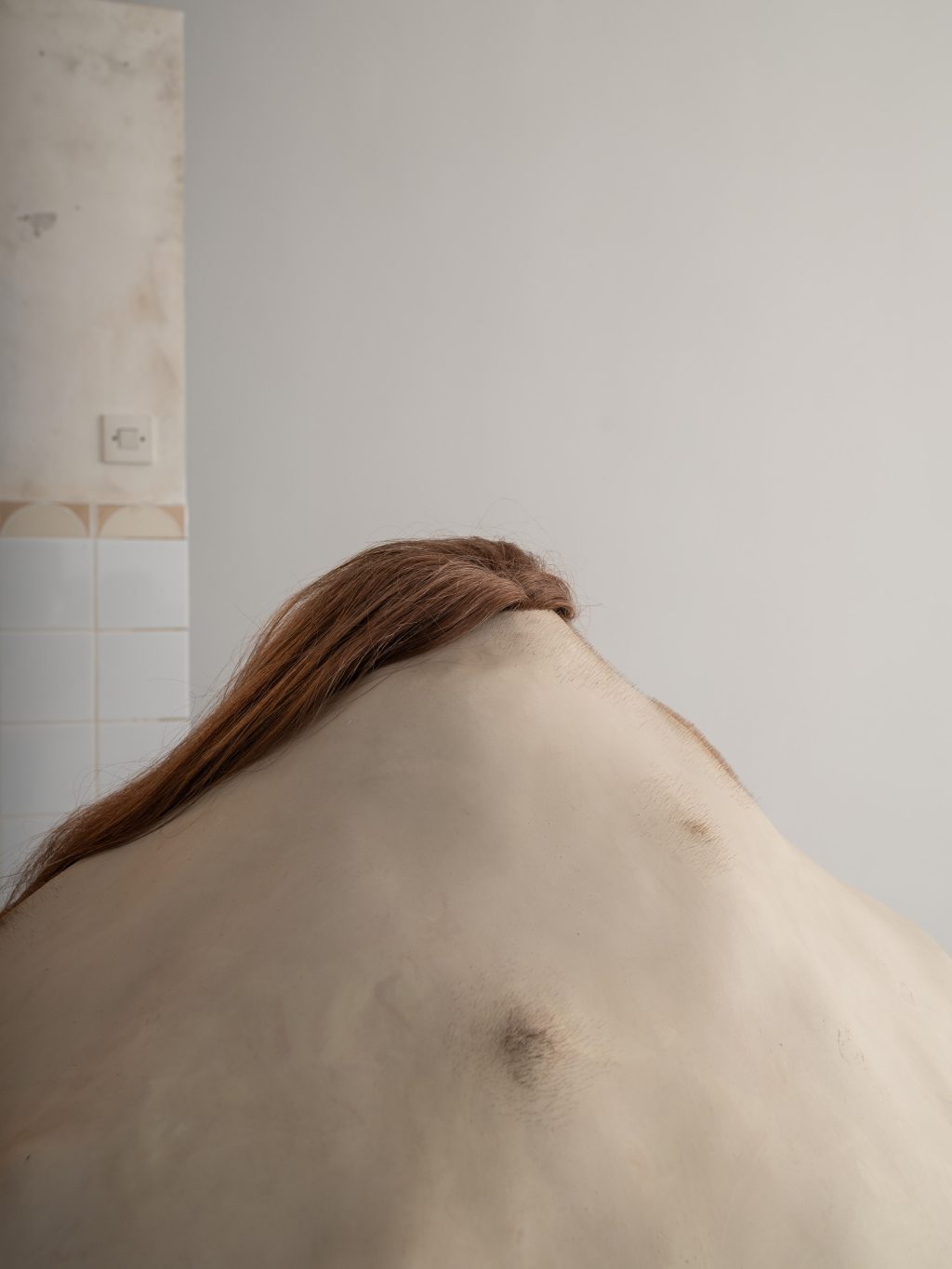
One of the sparks that led to the creation of Frizerski salon za brdo (Hairdresser for the Hill) is a documentary about an elderly woman from Nepal who, blinded by the harsh Himalayan sun, lived in the dark for many years. When she was finally able to see again, thanks to treatment she received at a mobile clinic – she gave a loud laugh. This is where Igor Ruf comes in, and things become… curious. “I want to know what happened after all that. What kind of sketchy information I got, and what the point is in all that, I ask myself, and meanwhile her hair keeps growing and growing.” (I.R.) Perhaps the old woman goes to a hairdresser’s, which perhaps exists, or perhaps the spectre of past haircuts yet awaits her. In Ruf’s vision, on the ocean of time, she is eternal. Like a hill. Like memory.
Following the narratives in Ruf’s installations is challenging and intentionally divergent. Events elude fast and clear identification, which frequently creates a sense of discomfort in viewers (a valuable reaction, when it has been successfully provoked). Nevertheless, through a refined technique designed to confuse, the foundation of his process breaks through clearly: rooting around in his own memories the duality of surfacing from the past and diving back into it once again. Endlessly returning, entering once more into past experiences, into the “in-betweens”, is an uncertain but unavoidable attempt to grasp at the essence of the thing. Just how far back must we go to find the beginning?
In Frizerski salon za brdo, too, Ruf exposes himself on a deeply personal level: through the hum of a song that he performs himself, through a variety of small personal items arranged in a cabinet de curiosités, through a comic he wrote, entitled Brdo smrdo i borovi (lit. Smelly Hill and the Pine Trees), in which the hair-cutting game is played out – a game he knows all too well from his childhood. Frizerski salon’s atmosphere has a scenographic power and is organised according to the principle of the antique shop; every item arranged within the work contributes its own history and meaning. The accumulation of various elements memories, and experiences creates a sense of an unusual, alternative space; a potential reality that opens up like a collection of meanings, rather than a linear sequence of events. As a result “art has one advantage over the utilitarian world – it does not have to function”.[5]
E
A tangerine is peeled
An unstruck sound is released[6]
TARWUK (Bruno Pogačnik Tremow and Ivana Vukšić) function as a symbiotic artistic entity – an “organism” that suspends individual identities for the sake of the freedom of collective creative expression. The act of creation (“and if it’s not I who it is, and what it is”) exists solely as a collaborative process, a continuous and intuitive mutual exchange. TARWUK’s dynamic brings to mind the surrealist cadavre exquis method[7] in which everyone involved can add fragmented interventions and encourage the organic growth of multidisciplinary works.
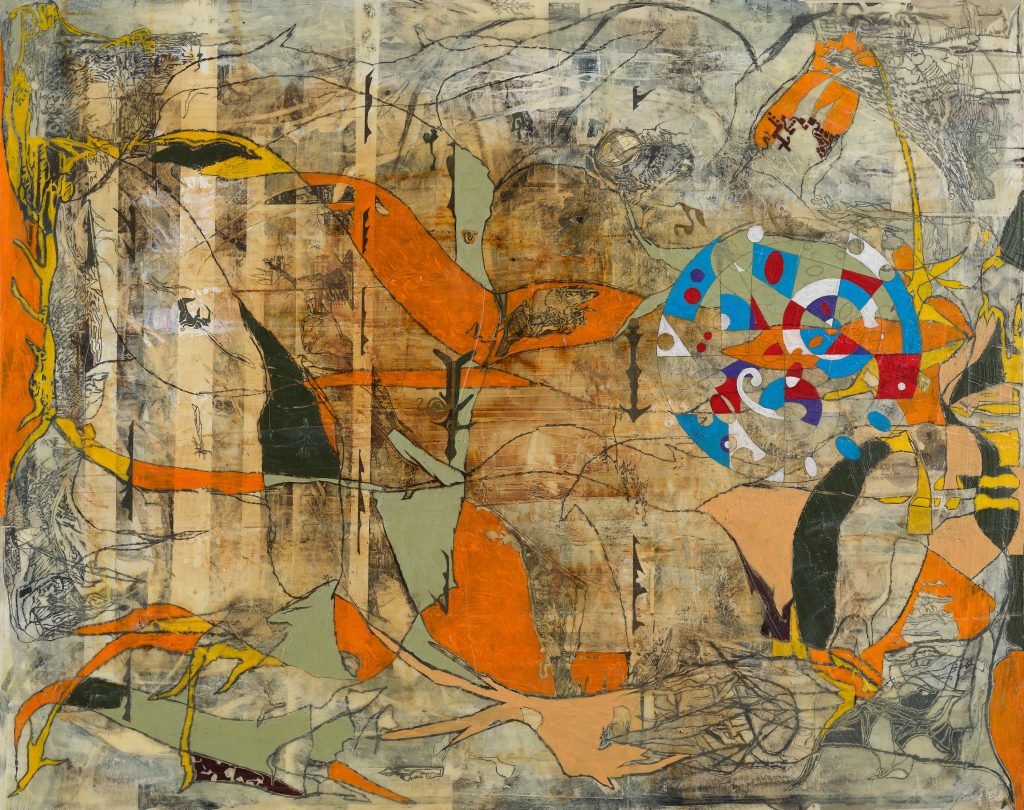
The painting E was conceived as a part of the installation Vernacular River Holds 6 Bodies Down, which is related to the short film Baka (Grandmother, 2018) in the genre of cinéma verité and SF, created in collaboration with Matthew Goedecke. In the film, members of a family play themselves, brought together at the table during a ritual matriarchal dinner where the main thing on the menu turns out to be – the grandmother. The installation, a combination of pictures, photographs, sculptures, props, and sounds, was arranged like a film set – an approach to creating exhibitions that TARWUK has been developing impressively in their recent projects. In TARWUK’s approach the mise-en-scène becomes a narrative frame for a performative situation – an atmosphere that the viewer enters with the belief that they are witnessing something that was already there. But they quickly realise that they are dislocated from the everyday and invited up to the stage to participate consciously.
The abstract landscape of E, with its orphic geometric sign, represents collective creation freed from predictability and a predetermined direction. Through an iterative approach – returning, adding to, reshaping – layers of materials and correspondences are created, while the image remains open, avoiding the clutches of fixed identification.
Between Here and There…Is 20 Hours Border Crossing
… the question may be asked, off the record, why time doesn’t pass, doesn’t pass, from you, why it piles up all about you, instant on instant, on all sides, deeper and deeper, thicker and thicker…[8]
When people migrate, they smuggle their own future across borders. They store it carefully, folded up with the past, alongside scraps of memories and hopes. A future that is neither linear, nor guaranteed; one that they still need to fight for. Quiet negotiations within identity take place, alongside a physical dislocation. Conflicts that arise from the development of something new within the old.
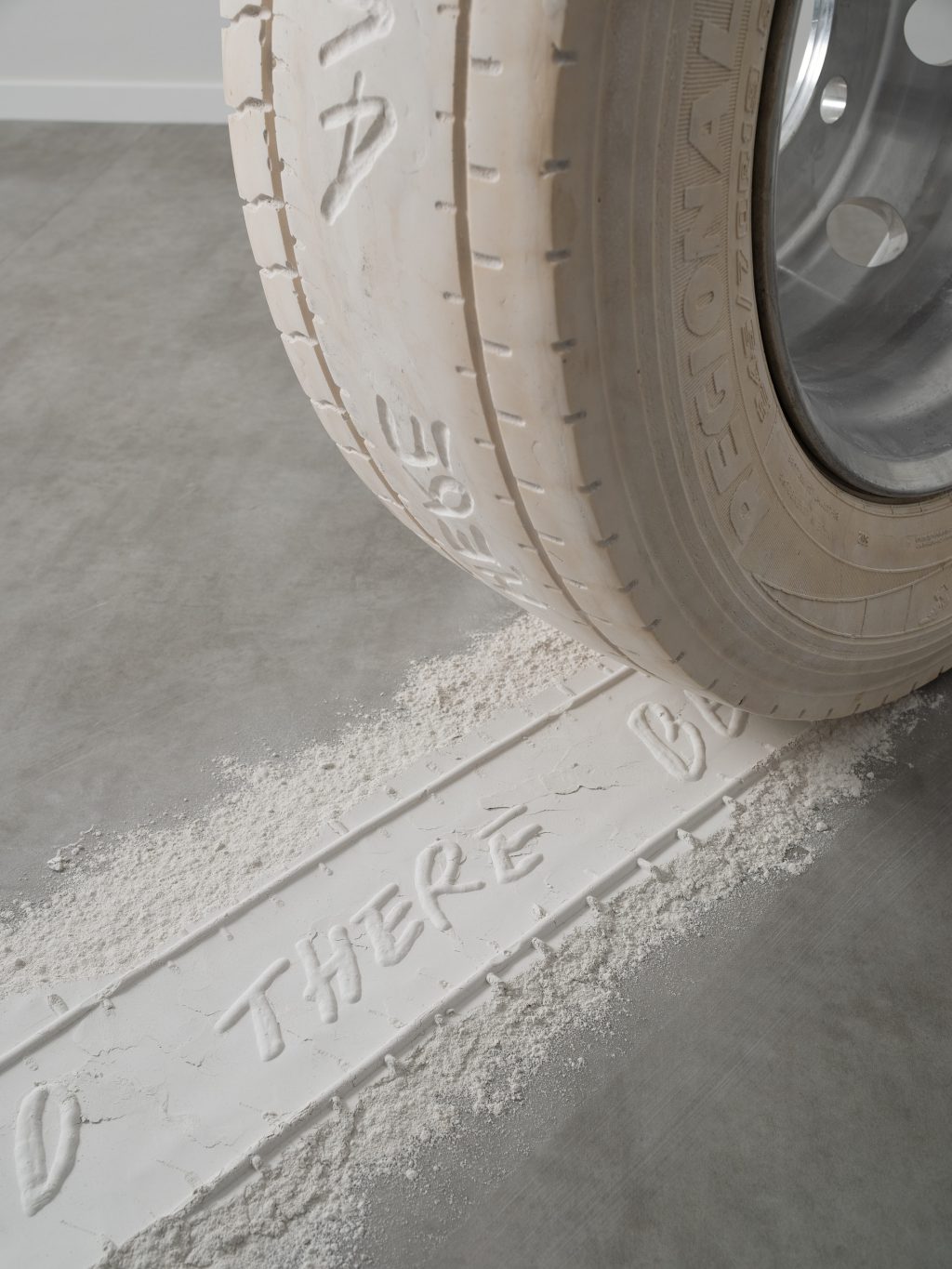
The most direct visualisation of the “in-betweens” is offered by Mila Panić in her recent works from the cycle Südost Paket (Southeast Package), which she has been developing since 2017. She channels the experience of living in the diaspora – at a temporal, spatial, and emotional “distance” – through an object: the bus tyre. A tyre that, as a capsule of a microcosmos, tumbles along the well-trod migrant route between Germany and Bosnia and Hercegovina. In earlier installations from this series, Panić used ready-made tyres, filling them with items such as cigarettes, perfume, and sweets; items that have a prestigious, though imaginary, status, and which frequently travel in migrants’ baggage. Her multimedial works personify the voices of “small histories”,[9] those that have remained on the margins of dominant narratives. They highlight the impossibility of establishing a unity between the personal and the collective, when actions and thoughts repeat until they lose their clarity and purpose, transforming into fear, anger, and existential paralysis. While some artists actively seek and investigate the absurd, Mila Panić finds it without looking. And cannot get away from it. And so she occupies it, twisting and transforming it into a sharp humour.
Her subtle installation at the Nirgendwo exhibition is also her most personal work from this cycle. Created using acrystal, as it turns the tyre leaves a trace in the dust, which spells out the words “Between Here and There”, an intimate poetization of her own uprooted identity. The tyre takes on the function of the white spectre of reality – present but shifting and impossible to catch, which is easily scattered, just like dust.
-text by Martina Marić Rodrigues
[1] Samuel Beckett, The Unnamed (L’Innommable)
[2] W.G.Sebald, Austerlitz
[3] Claude Lévi-Strauss, Wild Thought (La Pensée Sauvage)
[4] Igor Ruf’s voice interpretation, audio part of the Frizerski salon za brdo installation
[5] Predrag Pavić, Kako odliti vatru? (Izložba brda namještaja i hodajućih prostora I)
[6] Jen Fisher, A Musical Score at the End of the World (for Tarwuk)
[7] An artistic approach that developed within the French surrealist scene of the 1920s
[8] Samuel Beckett, The Unnamed (L’Innommable)
[9] Walter Benjamin, Theses on the Philosophy of History
About the artists
Mila Panić
Igor Ruf
Marko Tadić
TARWUK
Image credits: Marko Tadić, Souvenirs, 2007, installation, dimensions variable